Pastoralism in dryland areas
A case study in sub-Saharan Africa
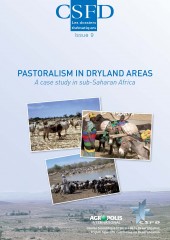
Often barren natural rangelands are directly utilized for pastoral livestock farming, which is by nature mobile (transhumance). This activity is on the rise in sub-Saharan Africa, providing a living for a great number of herders, generating marketable animal products, while also supporting pastoral-oriented societies.
Pastoral livestock farming prevails especially in dry tropical regions. The livestock farming techniques are continuously adjusted to adapt to extremely variable local conditions, i.e. the spatial distribution of resources (fodder, water) or sanitary, social and economic situations. Pastoralism is a source of meat, even for export, and has an important role in the agricultural economy of Sahelian countries. This activity enhances social stabilization and peace in marginal dryland areas.
Pastoralism is becoming difficult in sub-Saharan Africa despite these advantages, especially due to the recent worsening of climatic conditions. Collective rangeland grazing rights are not legally recognized and protected sufficiently to stave off the problem of crop farming expansion and landgrabbing by investors. Sub-Saharan pastoralism has considerably evolved to cope with this situation—increase in transhumance into new areas, partial settling of herding families and income diversification.
Cattle grazing modifies the long-term evolution of rangeland ecosystems (soil, vegetation, biodiversity), but these impacts also have some advantages (soil fertility transfer, seed dispersal, maintenance of natural environments). Environmental degradation, which in extreme cases leads to desertification, is usually the result of localized overtapping of resources or poor management. The causes of this degradation must be assessed since it is ultimately detrimental to pastoralism.
The conditions required for sustainable pastoralism generally depend on the public policies of each concerned country and current legislation. Professional pastoral farmers are getting organized and international organizations are beginning to take stock of the economic and ecological challenges concerning pastoralism for the future.